Product Manager · AI · EdTech · Fintech

Lyndsey
Reed

Building products at the intersection of human experience & technology

AI-native Product Manager and Product Engineer with a passion for building and refining products that sit at the intersection of education and fintech. I lead with a deep focus on user experience and company growth, bridging technical teams and business strategy to create products that matter.

10+ Years in EdTech & Fintech
MA Columbia University, Applied Linguistics
Dir. Director-level leadership & strategic planning
AI Native product focus across ML & generative AI

About & Background

A different kind of
Product Manager

I'm a Product Manager at the intersection of AI, fintech, and EdTech, with a background that most PMs don't have. I've been a software engineer, a director of technology, a director of training and education, and a university lecturer on three continents. All of that feeds directly into how I build products.

At Tradeify, I led end-to-end product development for TradeSage, an AI-native trading analytics and performance platform. I owned everything from initial vision and architecture through UX strategy, engineering collaboration, broker integrations, and go-to-market planning.

Before that, at Apex Trader Funding, I held several roles across the company. As the PM who led LMS selection and scaled the company's learning platform, I served the full workforce across multiple departments. As Director of Technology, I oversaw infrastructure and tooling for a rapidly scaling fintech operation. And as Director of Training and Education, I designed curriculum and training programs across departments that measurably improved operational efficiency and workforce competency.

I think AI-native product management is genuinely different from traditional PM work, and not just because the tools have changed. The role itself is shifting. When AI can generate solutions faster than most teams can evaluate them, the most valuable thing a PM brings is not speed or output. It is judgment. Knowing which problem is worth solving, which signal to trust, and where the model is confidently wrong. The PMs who treat AI as a layer on top of existing processes will be outpaced by the ones who rethink the process entirely around what AI actually changes. That is the work I find most interesting, and where I believe the field is heading.

My graduate work at Columbia University in Applied Linguistics gave me a deep understanding of how people construct meaning, frame problems, and communicate across different contexts. Language and code share structural logic, and that background made picking up programming more intuitive. Both inform how I work across technical and human sides of a product.

I completed a Graduate Certificate in Front-End Web Development at Harvard Extension School, and have hands-on experience in Python, JavaScript, SQL, Django, and Edge ML training. I completed an AI and full-stack development bootcamp at Le Wagon in Berlin, Germany and an AI Product Management certification at General Assembly, both of which sharpened how I think about building and shipping AI products.

The throughline across all of it is range. Teaching, building, leading teams, studying language, working across cultures. Each discipline has informed the others in ways that are hard to separate. That breadth is what I bring to product work.

Beyond the Work

Before technology became my medium, people were. I spent years teaching across the world: ESL in Tokyo, the West Bank, and Germany; linguistics and pedagogy at the university level in Turkey. Living and working inside those cultures shaped the way I listen, communicate, and build. I've traveled to over 30 countries, studied five languages, and that experience still shows up in how I think about users and cross-functional teams.

Outside of work I stay grounded through movement. Certified yoga teacher, dancer, flow arts practitioner, rollerskater, avid outdoors person. Discipline in one area tends to carry into everything else.

Focus Areas

AI/ML Products
Fintech Platforms
EdTech & Learning Systems
SaaS & B2B Products

Education

Columbia University, MA
Harvard Extension School
General Assembly, AI PM
Le Wagon, AI Dev Bootcamp
Portland State University, BA

Skills

Jira · Figma · Miro · Notion
Claude · ChatGPT · Cursor · OpenAI
SQL · Python · JavaScript
Agile · Scrum · OKRs
Wireframing · Prototyping

Location

Remote

Selected Work

Case Studies

01

Fintech · AI · 0 to 1

TradeSage, AI Trading Platform

Led end-to-end product development for an AI-powered trading analytics and performance platform, building from vision to go-to-market at Tradeify.

Read Case Study →
02

EdTech · Platform · Analytics

Apex LMS, Enterprise Learning Platform

Scaled a company-wide learning platform serving the full workforce across multiple departments, measurably improving knowledge outcomes through data-driven iteration.

Read Case Study →
03

Consumer · SaaS · AI · Social

Griffin's Kitchen, Living Family Cookbooks

A private, invitation-based social recipe platform letting families and communities create shared living cookbooks, with an AI layer and premium physical book upsell.

Read Case Study →
04

E-Commerce · Web Dev · Publishing

Unbound Books, Author Platform & Store

Designed and built a fully functioning e-commerce and author platform for an independent publisher, including a live store, photo journal, waitlist system, and email capture.

Read Case Study →
05

AI · EdTech · B2B SaaS · Venture Concept

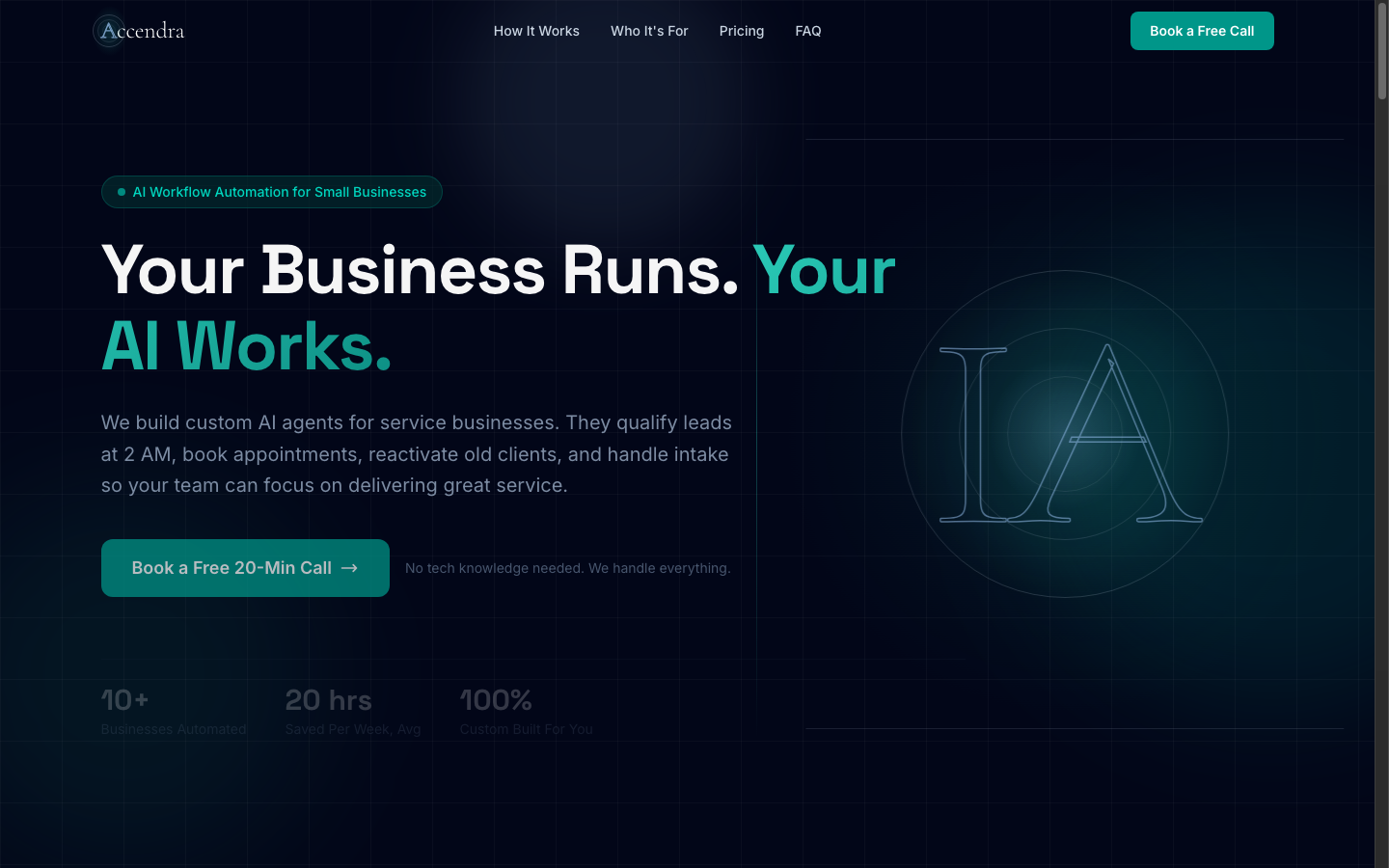
Accendra, AI-Powered Training Agents

A venture concept for an AI agent platform that transforms how organizations onboard, upskill, and retain talent — built from domain expertise in L&D and fintech.

Read Case Study →

Work Samples

PM Artifacts

Browse all documents and deliverables directly. Filter by type or search by keyword.

PRD

TradeSage

Journal Dashboard & AI Performance Layer

Product requirements for the core MVP — user stories, personas, success metrics, and acceptance criteria.

View Document →
BRD

TradeSage

Platform Relaunch

Business case for the relaunch — objectives, market opportunity, stakeholder requirements, and constraints.

View Document →
Roadmap

TradeSage

Product Roadmap

Phased build plan from discovery through differentiator features, with success metrics per phase.

View Document →
Feature Spec

TradeSage

Adaptive AI Coach

Full specification for the AI coaching engine — capabilities, technical approach, edge cases, and success metrics.

View Document →
Sprint

TradeSage

Sprint 1 — Discovery & Foundation

Sprint plan with goal, backlog, planning breakdown, ceremonies, and definition of done.

View Document →
Prioritization

TradeSage

Feature Categorization Table

Priority framework mapping 50+ features across must-have, should-have, and differentiator tiers.

View Document →
Roadmap

Apex LMS

Training Development Roadmap

Four-phase rollout plan for an enterprise learning platform — from discovery through optimization.

View Document →
OKRs

Apex LMS

FY Learning Platform OKRs

Three objectives with key results tied to platform adoption, knowledge quality, and business alignment.

View Document →
Sprint

Apex LMS

Sprint — Leadership Track Build

Sprint example with goal, backlog, planning session breakdown, and definition of done for a learning track build.

View Document →
PRD

Griffin's Kitchen

Core Platform PRD

Product requirements for a subscription recipe and meal-planning platform — personas, user stories, and metrics.

View Document →
Roadmap

Griffin's Kitchen

Product Roadmap

Phased go-to-market roadmap from MVP launch through community and monetization expansion.

View Document →
Feature Spec

Griffin's Kitchen

Core Feature Specification

Detailed spec for the platform's core features — requirements, edge cases, and acceptance criteria.

View Document →
OKRs

Griffin's Kitchen

Launch OKRs

Objectives and key results for the launch quarter — growth, engagement, and retention targets.

View Document →

Get In Touch

Let's
Talk

I'm actively exploring Senior PM and Staff PM roles in AI, EdTech, and Fintech. If you're building something ambitious and need a product leader who bridges technical depth with human-centered thinking, I'd love to connect.

I respond to every message. The best way to reach me is via email or LinkedIn.

Remote

AI Solutions for Business

I work with individuals and companies to design and build AI agents and custom chatbots. Whether you need a customer-facing chatbot, an internal knowledge agent, or a fully custom AI workflow, I can design and build it end to end.

See a Live Example →

Chat with
Lyndsey

AI-Powered Portfolio Interview

Ask me anything, about my experience, my approach to product decisions, or what I'm looking for next. This AI has been trained on my background and philosophy to give you a genuine sense of how I think.

Please note: this is an exploratory showcase, not a substitute for a real conversation. While the AI reflects my values and experience, responses may not always be fully accurate. I'd love to connect directly to continue the dialogue.

Try asking

AI Solutions for Business

What you're seeing is an example of what I can build for you — customer chatbots, internal agents, custom AI workflows.

Let's Build Something →
LR
Hi! I'm an AI trained on Lyndsey's background, experience, and how she thinks about product work. Ask me anything you'd ask in an interview, or just get to know her. I'm happy to talk through her projects, her philosophy, or what she's looking for next.

This is an AI representation of Lyndsey Reed. 10 messages remaining today.

Experience · Education · Skills

Resume

LocationRemote
StatusOpen to new roles ✓

AI-native Product Manager and Product Engineer with a passion for building and refining products that sit at the intersection of education and fintech. I lead with a deep focus on user experience, company growth, accountability and empathy, owning end-to-end product development from vision and roadmap through execution and go-to-market. With hands-on engineering experience, I bridge technical teams and business strategy to build products that deliver value to users and create impact for the business.

Columbia University New York, NY
Master of Arts, Applied Linguistics
Harvard Extension School Boston, MA
Graduate Certificate, Front-End Web Development
General Assembly New York, NY
Certification, AI Product Management
Le Wagon New York, NY
AI Software Development Bootcamp
Portland State University Portland, OR
Bachelor of Arts, Philosophy & Applied Linguistics
Portland State University Portland, OR
TESL Certification
Product Manager, AI & Fintech Platforms
Tradeify · Remote
Oct 2025 to Feb 2026
  • Led product development from 0 to 1 for an AI-native fintech platform, defining vision, architecture, and go-to-market strategy pre-launch
  • Built AI-powered experiences including real-time insights, performance journaling, behavioral signals, and personalized recommendations
  • Translated business goals into epics, user stories, PRDs, and prioritized backlogs using Jira and Confluence
  • Led UX strategy, design systems, and component handoffs to accelerate engineering delivery
  • Oversaw fintech integrations including broker syncing, analytics pipelines, KPI dashboards, and reporting systems
  • Partnered with engineering, design, marketing, and executive stakeholders to ship scalable solutions
Product Manager, Learning Platform & EdTech Systems
Apex Trader Funding · Remote
Sep 2024 to Aug 2025
  • Owned full product lifecycle for an enterprise LMS platform serving hundreds of employees across multiple departments
  • Applied data-driven learning analytics to measure platform effectiveness and continuously improve outcomes aligned with business KPIs
  • Built and shipped adaptive assessment features and interactive content modules using TalentLMS, H5P, and Articulate
  • Led agile ceremonies across cross-functional teams including instructional designers, trainers, and SMEs
  • Designed and launched leadership development pathways, onboarding tracks, and personal growth programs, improving accuracy and knowledge base by 30%
Product Manager, Technology & Infrastructure (Director of Technology)
Apex Trader Funding · Remote
Dec 2023 to Sep 2024
  • Served as technical product lead overseeing systems infrastructure and tooling for a rapidly scaling fintech operation
  • Identified operational gaps, defined solutions, and drove implementation of process improvements with measurable impact on training delivery
  • Acted as bridge between technology and learning, translating technical requirements into actionable product decisions
Software Engineer
Apex Trader Funding · Remote
Jul 2023 to Sep 2024
  • Built and maintained internal plugins and tools in direct collaboration with product
  • Developed technical foundations in system architecture, performance, and scalability
Freelance Product Consultant & Web Developer
Independent · Remote
2019 to 2023
  • Provided freelance web development and technology consulting services to clients across education and small business sectors
  • Completed Harvard Extension School Graduate Certificate in Front-End Web Development, building full-stack and Edge ML applications
Faculty Lecturer
Georgetown University & U.S. State Department · Turkey
Sep 2017 to Jul 2019
  • Taught undergraduate courses in linguistics, pragmatics, and mass media language in a joint appointment with the U.S. State Department
  • Established an international university partnership to build cross-cultural communication programs
  • Spearheaded community outreach programs expanding access to language education
Faculty Lecturer
City College of New York · New York, NY
May 2016 to May 2017
  • Designed and delivered curriculum for diverse learners advancing English language proficiency through communicative, project-based methods
Product ToolsJira, Confluence, Asana, Monday.com, Miro, Notion, Figma
DesignWireframing, Prototyping, Figma
AI & LLM ToolsClaude, ChatGPT, Cursor, GitHub Copilot, OpenAI API, Perplexity, Midjourney
Analytics & DataGoogle Analytics, Tableau, SQL, Excel
DevelopmentHTML, CSS, JavaScript, Python, Django, SQL, Git, WordPress
EdTech PlatformsTalentLMS, Articulate 360, H5P, Instructure Canvas
MethodologiesAgile, Scrum, Design Thinking, OKRs, User Story Mapping, A/B Testing

Fintech · AI/ML · 0 to 1 Product

TradeSage, AI Trading Analytics Platform

CompanyTradeify
RoleProduct Manager, AI & Fintech
TimelineOct 2025 to Feb 2026
Stage0 to 1, Pre-launch

Retail traders had data but no insight

Most traders on funded platforms could see their raw numbers but couldn't extract meaning from them. They had no way to identify behavioral patterns driving losses, no psychological tracking, and no personalized coaching. The tools that existed were either too generic or too complex. The gap was clear: an AI-native performance layer built specifically for how traders actually think and fail.

A dual-purpose platform with a clear market position

TradeSage was designed to function two ways simultaneously: as an embedded journal inside the funded trading dashboard for prop traders, and as a standalone product for retail traders, trading coaches, and trading groups. The mission was to empower traders to understand their performance, identify behavioral and technical patterns, and evolve into consistently profitable traders through clean data visualization and automated AI insights.

The competitive bet was on combining sophisticated AI analysis with social engagement features and seamless broker integrations — capabilities that point solutions in the market weren't offering together.

End-to-end ownership from blank page to go-to-market

  • Conducted discovery through competitive analysis, trader interviews, and support ticket research to define the core problem space
  • Defined a 4-phase roadmap spanning rebrand through AI ecosystem expansion, balancing speed to market with product depth
  • Prioritized 50+ features across 6 product areas using a Must-Have / Should-Have / Differentiator framework
  • Partnered cross-functionally with engineering, design, data science, and marketing to align on scope and sequence
  • Oversaw broker integrations, AI coaching layer, analytics pipelines, and psychological performance tracking
  • Defined success metrics including 100K MAU target and 70% 90-day retention as north star KPIs

Six core product areas, fully scoped

Advanced Analytics

P&L summaries, win rate, time and instrument-based performance, behavioral analytics, and auto edge detection.

AI Coaching

AI-first interface, daily insights, adaptive AI Coach engine, auto mistake detection, and voice-to-journal.

Psychology

Emotional tagging, morning check-ins, discipline scores, fatigue detection, and psychological performance scoring.

Replay & Backtesting

Session and trade-by-trade replay, strategy comparison, what-if simulations, and prop rule stress testing.

Prop Readiness

Prop rules engine, compliance tracking, violation alerts, multi-prop management, and readiness scoring.

Education & Social

Stage-based education, playbooks, leaderboards, mentor workspaces, and AI-generated review packets.

A fully scoped 0-to-1 AI product

0→1
Full product built from blank page to structured go-to-market plan
50+
Features prioritized across 6 product areas
4
Roadmap phases defined from rebrand through AI ecosystem
4
Target markets: prop traders, retail, coaches, options traders

AI products require a fundamentally different validation process

You can't test a recommendation engine the same way you test a button. I invested heavily in defining what "good" looked like for each AI output before any model code was written. In fintech, the trust gap is the product problem — users must understand and trust AI recommendations before acting on them. That insight shaped every UX and copy decision.

Product Roadmap — Full Strategic Plan

A comprehensive strategic plan for rebuilding, rebranding, and relaunching TradeSage as the leading AI-powered trading journal platform.

Open full roadmap ↗

Feature Categorization Table

A full breakdown of 50+ features across six product areas, prioritized by Must-Have, Should-Have, and Differentiator tiers.

Open full table ↗

Planning & prioritization documents

Deep-dive documents from the TradeSage buildout.

Roadmap

TradeSage Product Roadmap

4 phases · Q4 2025 – 2027 · AI trading journal platform

Feature Prioritization

Feature Categorization Table

6 product areas · Must-Have / Should-Have / Differentiator

PRD

Journal Dashboard & AI Performance Layer

Core MVP · AI insights · behavioral analytics

BRD

TradeSage Platform Relaunch

Business case · market opportunity · stakeholder requirements

Feature Spec

Adaptive AI Coach

AI coaching engine · behavioral signals · personalized guidance

Sprint Example

Sprint 1 — Discovery & Foundation

Phase 1 · user research · baseline metrics · brand foundation

Roadmap · Fintech · AI Trading Platform

TradeSage Product Roadmap

ProductTradeSage
TimelineQ4 2025 – 2027
Phases4 · Rebrand through AI Ecosystem
TypeSample Work · Strategic Roadmap

TradeSage needed to evolve from an embedded analytics layer into a standalone, market-leading AI trading journal. This roadmap outlines the full strategic arc from rebrand through ecosystem expansion — balancing speed to market with product depth.

Phase Timeline Focus
Phase 1 · Relaunch & Rebrand Q4 2025 · 1–2 months User research, UI/UX overhaul, brand refresh, baseline data foundation
Phase 2 · Product Expansion Q1–Q2 2026 · 3 months Feature parity, full AI/LLM integration, enhanced analytics, broker integrations, social features
Phase 3 · Growth & Monetization Q3–Q4 2026 Freemium model, affiliate partnerships, white-label for prop firms, enterprise plans
Phase 4 · AI Ecosystem 2027 Advanced pattern recognition, predictive analytics, deep platform integrations, strategic partnerships
100K
Monthly active users target within 12 months
70%
90-day user retention goal
4
Target markets: prop traders, retail, coaches, options traders

Complete strategic plan

A full walkthrough of the TradeSage product strategy — architecture, phases, monetization, and long-term vision.

Open full roadmap ↗

PRD · Product Requirements Document · Fintech AI

Journal Dashboard & AI Performance Layer

ProductTradeSage
Feature AreaCore MVP · Phase 1
StatusDraft · In Development
AuthorLyndsey Reed, PM
Sample artifact — created to demonstrate PM methodology and approach. This does not represent actual internal documentation from any employer.

Problem statement

Funded and retail traders generate significant trade data but lack the tools to extract behavioral and performance insight from it. Existing journaling platforms offer raw data views without meaningful synthesis. TradeSage's Journal Dashboard solves this by combining a clean journaling interface with an AI performance layer that surfaces patterns, flags anomalies, and delivers personalized coaching — all in one place.

What this PRD covers

In Scope

  • Daily and weekly P&L summary views
  • Win rate, drawdown, and basic performance stats
  • Time-based and instrument-based performance breakdowns
  • AI-generated daily performance notes
  • Emotional tagging and morning check-in flow
  • Discipline score calculation and display
  • Benchmark tracking against prior periods
  • Weekly and monthly summary generation

Out of Scope (Phase 2+)

  • Trade replay and backtesting engine
  • Multi-broker API integrations
  • Social sharing and leaderboards
  • Adaptive AI coaching engine
  • Prop rules compliance engine
  • White-label configurations

Who we are building for

Primary — Prop Trader

Uses TradeSage inside the funded platform dashboard. Needs prop rule compliance visibility, daily P&L tracking, and performance pattern identification to protect their funded account.

Secondary — Retail Trader

Standalone subscriber. Wants to improve consistency, understand behavioral patterns behind losses, and receive actionable AI coaching without needing to interpret raw data themselves.

Tertiary — Trading Coach

Monitors student performance. Needs access to trade breakdowns, discipline scores, and behavioral trend data to deliver informed coaching feedback.

Core requirements expressed as stories

ID User Story Priority
US-01As a trader, I want to see my daily P&L summary so I can track performance at a glance without manually calculating results.Must-Have
US-02As a trader, I want to tag my emotional state on each trade so I can identify how psychology impacts my performance over time.Must-Have
US-03As a trader, I want to receive an AI-generated performance note each day so I can understand what my data means without manual analysis.Must-Have
US-04As a trader, I want to complete a morning check-in before trading so I can track how my mental state correlates with session outcomes.Must-Have
US-05As a trader, I want to see performance broken down by time of day and instrument so I can identify when and what I trade best.Must-Have
US-06As a trader, I want a discipline score calculated each session so I can hold myself accountable to my trading rules.Must-Have
US-07As a trader, I want weekly and monthly summary reports so I can review progress over longer timeframes without rebuilding data manually.Should-Have
US-08As a coach, I want to view a student's discipline score and emotional trend data so I can give informed feedback during sessions.Should-Have

How we measure done

≥65%
Daily active users completing morning check-in within first week
≤2 min
Time from login to full dashboard view loaded
70%
90-day retention rate as north star product health metric

BRD · Business Requirements Document · Fintech

TradeSage Platform Relaunch

ProductTradeSage
InitiativePlatform Relaunch
PhasePhase 1
AuthorLyndsey Reed, PM
Sample artifact — created to demonstrate PM methodology and approach. This does not represent actual internal documentation from any employer.

Business case for the relaunch

TradeSage exists as an embedded analytics feature within a funded trading platform. The opportunity is to transform it into a dual-purpose, standalone AI trading journal that competes directly in the trade journal market while retaining its embedded value for prop traders. The relaunch requires a full rebrand, UX overhaul, AI integration, and go-to-market strategy targeting four distinct customer segments.

What success looks like at the business level

  • Establish TradeSage as a recognized, standalone brand in the AI trading journal market
  • Achieve 100,000 monthly active users within 12 months of relaunch
  • Reach 70% 90-day user retention demonstrating genuine product value
  • Generate recurring revenue through a freemium model with Standard ($24/mo) and Pro ($33/mo) tiers
  • Capture enterprise and white-label revenue from prop firms and trading education companies
  • Build an affiliate program that drives scalable, low-cost user acquisition

Why now and why this product

The trading journal market is growing alongside the rise of retail and prop trading. Existing tools are fragmented — some offer analytics, some offer journaling, none offer a unified AI coaching layer. TradeSage's competitive position is the combination of all three plus social engagement features, giving it a moat that point solutions cannot easily replicate.

4
Target segments: prop traders, retail, coaches, options traders
$24–33
Monthly subscription tiers for standard and pro users
3–6 mo
Free trial strategy to capture market share at launch

What each stakeholder needs

Stakeholder Primary Need Success Criteria
ProductClear scope, phased roadmap, defined success metricsPhase 1 delivered on time with baseline data established
EngineeringClearly defined requirements, prioritized backlog, stable API contractsNo scope creep mid-sprint; acceptance criteria clear before dev starts
DesignBrand direction, design system ownership, user research accessComplete design system delivered before Phase 2 build begins
MarketingRebranded assets, positioning framework, launch timelineWebsite and brand refresh live at Phase 1 close
BusinessRevenue growth, market share, retention metrics100K MAU within 12 months, 70% 90-day retention

Known limitations going in

  • Phase 1 timeline is 1–2 months — research, design, and rebrand must run in parallel
  • Baseline data access (support tickets, usage counts, revenue) required before KPIs can be formally set
  • Broker API integrations are Phase 2 — Phase 1 relies on manual data import via CSV
  • AI coaching layer (AI Coach) requires model training data that won't exist until users are active on the platform
  • White-label and enterprise features are Phase 3 — early enterprise conversations must be managed against roadmap commitments

Feature Spec · AI Coaching · Differentiator

Adaptive AI Coach

ProductTradeSage
PhasePhase 2 · Differentiator Tier
TypeAI/ML Feature · LLM Integration
AuthorLyndsey Reed, PM
Sample artifact — created to demonstrate PM methodology and approach. This does not represent actual internal documentation from any employer.

An adaptive AI coach that learns how each trader thinks

AI Coach is TradeSage's core AI differentiator — a conversational coaching engine that analyzes a trader's journal data, behavioral signals, and performance patterns to deliver personalized guidance. Unlike static rule engines or generic AI chat, AI Coach adapts its coaching style and recommendations to each user's specific setup, tendencies, and psychological profile over time.

What AI Coach does

Daily Insights

Generates a personalized daily performance note after each session, surfacing patterns the trader may not have noticed.

Auto Mistake Detection

Identifies recurring errors — overtrading after losses, ignoring stop rules, trading outside peak hours — and flags them proactively.

Guardrails

Pre-session rule checks and real-time alerts when a trader's behavior starts drifting from their own defined trading plan.

Voice to Journal

Allows traders to dictate post-trade notes verbally. AI Coach transcribes, categorizes, and links the note to the relevant trade automatically.

AI Unlock Gating

Advanced AI Coach features unlock progressively as a trader builds journal history, incentivizing consistent use and creating a natural upsell path.

Usage-Based Credits

AI analysis depth is governed by a credit system. Free users get daily insights; Standard and Pro users get full coaching access.

How it works under the hood

  • LLM integration (GPT-4 / Claude) with structured prompting built on each user's journal data as context
  • Behavioral signal pipeline aggregates emotional tags, discipline scores, time-of-day patterns, and setup performance into a user profile
  • Anomaly detection layer flags statistical outliers in the user's own data — not generic benchmarks
  • Voice transcription via Whisper API; structured output routed to journal entry via post-processing pipeline
  • Unlock gating controlled by a journal history threshold — minimum 10 sessions before advanced coaching activates

What could go wrong

  • New users have insufficient journal history for meaningful AI output — mitigated by generic onboarding insights until threshold is reached
  • LLM hallucinations in financial context are high risk — all AI output is labeled as guidance, not financial advice, with clear disclaimer copy
  • Voice transcription accuracy degrades in noisy environments — fallback to manual entry always available
  • AI unlock gating may frustrate power users — Pro tier bypasses minimum session requirement
≥40%
Daily active users engaging with AI Coach insights within 30 days
≥3x
Higher 90-day retention for AI Coach users vs. non-users
<5%
AI insight dismissal rate — low dismissal signals perceived value

Sprint · Phase 1 · Discovery & Foundation

Sprint 1 — Discovery & Foundation

SprintSprint 1 of Phase 1
Duration2 weeks
Capacity20 story points
StatusComplete
Sample artifact — created to demonstrate PM methodology and approach. This does not represent actual internal documentation from any employer.

Establish the research and data foundation for the relaunch

This sprint focused on completing the discovery work required before any design or engineering could begin. The goal was to understand the current user base, define the competitive landscape, and establish baseline metrics — so every subsequent decision would be grounded in real data rather than assumptions.

How the sprint ran

Team

  • PM — Lyndsey Reed (sprint lead, discovery owner)
  • Design — UI/UX lead (competitive audit, moodboard)
  • Engineering — 1 full-stack (data access, platform assessment)
  • Data — 1 analyst (usage pattern pull, support ticket synthesis)

Ceremonies

  • Sprint planning — 2 hrs, day 1
  • Daily standups — 15 min async via Slack
  • Mid-sprint check-in — 30 min, day 7
  • Sprint review — 1 hr, day 14
  • Retrospective — 45 min, day 14

How the planning session was structured

The backlog was groomed in the week prior, so planning focused on commitment and clarity — not estimation or debate. Stories were reviewed, questions were answered, and the team left with a shared goal and a clear first action.

Part 1 · 45 min

What are we building?

  • PM presents sprint goal and top backlog items
  • Team asks clarifying questions on each story
  • Acceptance criteria reviewed and confirmed
  • Oversized stories split before committing

Part 2 · 60 min

How are we building it?

  • Team pulls stories into sprint and confirms estimates
  • Engineers break work into tasks and flag dependencies
  • Capacity checked against availability and carry-over
  • Blockers and risks surfaced before work begins

Part 3 · 15 min

Alignment and close

  • Sprint goal stated clearly and agreed on by all
  • Each person confirms their first action item
  • Risks and open questions logged in Notion
  • Definition of Done confirmed for this sprint's story types

Sprint backlog

ID Story SP Status
S1-01Conduct 5 user interviews with current platform traders to surface key pain points with the existing journal experience.5Done
S1-02Pull and synthesize 90 days of support ticket data to identify recurring product complaints and feature requests.3Done
S1-03Complete competitive audit of 5 trading journal platforms documenting feature gaps and positioning opportunities.5Done
S1-04Extract baseline metrics: MAU, DAU, feature usage frequency, and CSV import adoption rates from current platform.3Done
S1-05Deliver initial brand direction moodboard and present two visual identity directions to stakeholders for alignment.4Done

Acceptance criteria applied to all stories

  • All research artifacts documented and shared in Notion before sprint review
  • User interview insights synthesized into a findings summary with direct quotes
  • Baseline metrics documented in a shared data dashboard accessible to all stakeholders
  • Competitive audit delivered as a comparison matrix with clear opportunity callouts
  • Brand moodboard reviewed and one direction selected by sprint close
20
Story points completed — full sprint capacity delivered
5/5
User stories shipped by sprint close
1
Brand direction selected and approved for Phase 1 design work

Feature Prioritization · Fintech · AI Trading Platform

Feature Categorization Table

ProductTradeSage
FrameworkMust-Have · Should-Have · Differentiator
Areas6 product categories · 50+ features
TypeSample Work · Feature Prioritization

With a broad product surface spanning analytics, AI coaching, psychology, and education, prioritization was critical. This framework organized 50+ features across six areas into three tiers — what had to ship, what should ship, and what would differentiate TradeSage in a competitive market.

Must-Have

Core functionality required for launch. Without these, the product doesn't work.

Should-Have

High-value features that round out the experience and drive retention.

Differentiator

Competitive moat features that set TradeSage apart in a crowded market.

All categories and priorities

A complete breakdown of features across Advanced Analytics, Psychology, Education, Replay & Backtesting, AI Coaching, and Prop Readiness.

Open full table ↗

EdTech · Enterprise Platform · Data-Driven

Apex LMS, Enterprise Learning Platform

CompanyApex Trader Funding
RolePM, Learning Platform & EdTech Systems
TimelineAug 2023 to Aug 2025
ScaleFull workforce, multiple departments

A fast-scaling fintech with no scalable way to train its people

Apex was growing rapidly but training wasn't keeping pace. Knowledge was siloed, onboarding was inconsistent, and there was no systematic way to measure whether training was actually working. New hires took too long to ramp and the company lacked infrastructure to support a growing, distributed team.

Treating the LMS as a product, not a project

  • Ran discovery across departments to map knowledge gaps and friction points
  • Defined platform requirements, managed vendor relationships, drove adoption
  • Ran agile ceremonies with instructional designers, trainers, and SMEs
  • Built adaptive assessments and interactive modules using TalentLMS, H5P, and Articulate
  • Applied learning analytics continuously to identify drop-off points and iterate

Measurable impact across the organization

Full org
Entire workforce unified on a single learning platform
Measurable
Improvement in knowledge accuracy and retention post-launch
All depts
Departments aligned on a unified learning system

Learning design is product design

The principles of good product design and good learning design are nearly identical. Both require understanding the user's goal, removing friction, and measuring whether the experience worked. My background in linguistics and instructional design wasn't separate from the PM work, it was the PM work.

AI Knowledge Assistant — Full Case Study

A detailed walkthrough of an AI support training initiative, covering architecture, implementation challenges, and measurable outcomes.

Open full presentation ↗

Leadership Development Pathway

A comprehensive approach to building consistent leadership capabilities from front-line supervisors to executive leadership, including program structure, blended learning methodology, and business impact.

Open full presentation ↗

Onboarding Redesign: A Success Story

A comprehensive approach to standardizing and optimizing an employee onboarding experience, including AI-powered personalization, cross-functional collaboration, and measurable reduction in onboarding time.

Open full presentation ↗

Department-Specific Learning Pathway Audit & Redesign

A strategic audit spanning multiple departments — eliminating redundant content, creating role-based learning journeys, and reducing time-to-proficiency.

Open full presentation ↗

Planning & Execution Documents

Process artifacts from the Apex LMS buildout — the roadmap, OKRs, and sprint documentation that drove execution.

Roadmap

Training Development Roadmap

Q3 2023 – Q3 2024 · 4 phases · full LMS buildout

OKRs

FY 2024 Objectives & Key Results

3 objectives · 9 key results · outcomes mapped to KPIs

Sprint Example

Sprint 12 — Leadership Track Build

5 user stories · 18 SP · 2-week sprint

Roadmap · EdTech · LMS Platform

Training Development Roadmap

CompanyApex Trader Funding
TimelineQ3 2023 – Q3 2024
PlatformTalentLMS · H5P · Articulate
StatusAll Phases Complete

Apex was scaling rapidly with no centralized training infrastructure. This roadmap defined the full buildout from platform selection through optimization — structured in four phases to balance speed of delivery with quality of output.

Phase Quarter Epics & Deliverables Status
Phase 1: Foundation
Infrastructure & Alignment
Q3 2023
  • LMS vendor evaluation & selection (TalentLMS)
  • Platform configuration, branding, SSO setup
  • Training needs assessment across all departments
  • Stakeholder alignment & communications plan
  • Admin training for department leads
Complete
Phase 2: Core Build
Launch & First Rollout
Q4 2023
  • General onboarding track v1 — built & launched
  • Support department track — built & launched
  • Content migration from legacy systems
  • Pilot cohort (select employees) — feedback & iteration
  • Initial learning analytics baseline established
Complete
Phase 3: Scale
Depth & Breadth
Q1–Q2 2024
  • Leadership development pathway — all managers
  • Dept-specific tracks across core functions
  • Adaptive assessments built in H5P
  • Interactive modules via Articulate 360
  • Learning analytics dashboard — live reporting
  • Mentorship program integration
Complete
Phase 4: Optimize
Measurement & Iteration
Q3 2024
  • Cross-dept pathway audit across all departments
  • Redundancy elimination — significant content reduction
  • Role-based learning journey redesign
  • KPI alignment review — all objectives remapped
  • AI personalization pilot planning
  • Succession planning integration
Complete
Full org
Entire workforce on a unified learning platform
All depts
Training content audited and restructured across all departments
Significant
Reduction in new hire ramp time vs. prior baseline
Measurable
Improvement in knowledge accuracy and assessment scores

OKRs · FY 2024 · Learning & Development

FY 2024 Objectives & Key Results

CompanyApex Trader Funding
PeriodJanuary – December 2024
OwnerPM, Learning Platform & EdTech Systems
StatusAll Objectives Met

These OKRs were set at the start of FY 2024 to align the learning platform's development directly to business outcomes. Each key result was designed to be measurable, time-bound, and tied to a departmental KPI. Progress was reviewed monthly with department heads and reported to leadership quarterly.

Build a scalable, world-class learning infrastructure for a rapidly growing fintech organization

KR 1.1

Launch LMS platform serving 100% of employees by end of Q1 2024

100% — Met Q1

KR 1.2

Achieve 80%+ completion rate on all mandatory training tracks by Q3

82% — Met

KR 1.3

Reduce new hire ramp time significantly from an extended baseline by Q2

Target exceeded

Improve measurable knowledge quality and competency outcomes across all departments

KR 2.1

Measurably improve knowledge accuracy scores vs. prior year baseline across key departments

Target exceeded Q3

KR 2.2

Deploy adaptive assessments across all core departments by end of Q2

All depts — Met Q2

KR 2.3

Achieve 4.2/5.0 average satisfaction score on training programs (quarterly survey)

4.3/5.0 — Exceeded

Align organizational learning directly to business performance and measurable outcomes

KR 3.1

Map 100% of training objectives to departmental KPIs across all departments by Q1

100% — Met Q1

KR 3.2

Launch leadership development program covering 100% of managers across all departments by Q2

100% coverage — Met

KR 3.3

Deliver monthly learning analytics report tied to business metrics starting Q2

7 reports delivered — Met

Sprint Planning · Agile · LMS Build

Sprint 12 — Leadership Track Build

SprintLeadership Track Build · 2 weeks
Capacity18 story points
EpicLeadership Development Pathway
StatusCompleted — All stories shipped

Design, build, and deploy the front-line leadership learning track in TalentLMS — fully tested, assigned to a pilot cohort of managers, and ready for structured feedback collection.

Team

  • L. Reed — PM & Sprint Lead
  • 2 × Instructional Designers
  • 1 × LMS Administrator
  • 1 × QA / Content Reviewer

Ceremonies

  • Sprint Planning — Aug 5, 9:00am
  • Daily Standup — 9:00am daily
  • Sprint Review — Aug 16, 2:00pm
  • Retrospective — Aug 16, 3:30pm
LDP-41 Structured learning path for front-line managers
High 5 SP

As a front-line manager, I want a defined learning path so I know exactly what to complete to develop my leadership skills.

Acceptance Criteria

  • Path contains 5 modules in logical sequence with time estimates
  • Each module has a clearly stated learning objective
  • Path appears in manager's TalentLMS dashboard upon assignment
LDP-42 Role-based track assignment by admin
High 3 SP

As a training admin, I want to assign the leadership track to specific user groups so I can control access and track completion at scale.

Acceptance Criteria

  • Track assignable by user group in TalentLMS admin panel
  • Completion tracked at individual level with timestamps
  • Admin can view team progress without contacting IT
LDP-43 Manager progress dashboard for department heads
Medium 3 SP

As a department head, I want to see my team's completion rates so I can track progress toward our Q2 leadership development goals.

Acceptance Criteria

  • Dashboard shows completion % per direct report
  • Report is exportable to CSV
  • Accessible with department head role (no LMS admin required)
LDP-44 Knowledge checks at end of each module
High 5 SP

As a learner, I want a knowledge check at the end of each module so I can verify my understanding before progressing to the next.

Acceptance Criteria

  • Minimum 5 questions per module, built in H5P
  • Pass threshold 80%; unlimited retakes permitted
  • Score recorded in learner's completion record
LDP-45 Pilot cohort enrollment & feedback survey trigger
High 2 SP

As the PM, I want 25 managers enrolled in the pilot track so I can gather structured feedback before full organizational rollout.

Acceptance Criteria

  • Pilot group of 25 created and enrolled in TalentLMS
  • Enrollment notification emails confirmed delivered
  • Feedback survey auto-triggers on track completion
  • All content reviewed and approved by subject matter expert
  • Modules built, tested, and validated in TalentLMS staging environment
  • Knowledge checks built in H5P, pass threshold confirmed
  • Pilot group enrolled in production; notifications confirmed
  • Feedback survey live and trigger tested end-to-end
  • Sprint review demo completed with department head stakeholders
18
Story points completed — full sprint capacity
5/5
User stories shipped by sprint close
25
Managers enrolled in pilot cohort

Consumer · SaaS · AI · Social Platform

Griffin's Kitchen, Living Family Cookbooks

TypeProduct Concept & Business Plan
ModelFreemium SaaS + Physical Upsell
TargetFamilies, Cultural Communities

Family recipes and food heritage are disappearing

Grandma's handwritten recipe cards get lost. A family's secret sauce nearly dies with a generation. Diaspora communities lose their food culture one generation at a time. Existing apps treat food as content, exposing personal recipes in algorithm-driven feeds designed for strangers, not families. Nobody owned the private, intimate space where families preserve and grow their food heritage together.

A private living cookbook that gets richer over time

Griffin's Kitchen is a private, invitation-based social recipe platform. Families and cultural communities create shared "pods", living digital cookbooks that grow richer over time. Members add recipes, attach personal stories and memories, tag contributors, and trace the origin of every dish. The AI layer surfaces suggestions based on available ingredients and dietary needs. The ultimate upsell: a beautifully designed, professionally printed hardcover cookbook generated from any pod's collection.

Freemium SaaS with a high-margin physical product upsell

  • Freemium tier drives adoption; paid tier unlocks advanced AI features and unlimited contributors
  • Premium physical cookbook fulfillment, printed hardcovers generated on demand at high margins
  • Target: $22K MRR at 12 months with a clear path to acquisition
  • Primary audiences: South Asian, Latin American, and diaspora communities; multigenerational families

A massive untapped market hiding in plain sight

$607M
ARR opportunity at 0.1% of addressable market
$22K
Target MRR at 12 months post-launch
High
Margin physical book upsell as primary revenue driver

Why private-first changes everything

The most important early product decision was committing to a private, invitation-based model. Privacy is the core value proposition, it's what makes users comfortable sharing a grandmother's handwritten card or a dish with deep personal meaning. Private-first means slower top-of-funnel growth but dramatically higher retention and willingness to pay. The physical book upsell isn't a forced add-on, it's the natural culmination of everything a pod builds together.

Sample product work drawn from this concept

The following artifacts were developed from the Griffin's Kitchen business plan to illustrate PM deliverable formats.

PRD

Pod Creation & Invite System

Core MVP feature · Week 1–2 · private invite model

Roadmap

12-Week MVP Roadmap

6 phases · Foundation through Growth

Feature Spec

Printed Cookbook Export

Print-on-demand · Lulu xPress API · $45–65

OKRs

Year 1 Growth OKRs

Revenue milestones · retention · community growth

PRD · Product Requirements Document

Pod Creation & Invite System

ProductGriffin's Kitchen
Feature AreaCore Platform · MVP Week 1–2
StatusDraft · Concept Phase
AuthorLyndsey Reed, PM

Problem statement

Families have no private, shared digital space to collect and preserve recipes together. Existing platforms are built for public audiences, not intimate family groups. Griffin's Kitchen solves this through "pods" — private, invitation-only spaces where families and communities build living cookbooks together.

The Pod Creation & Invite System is the foundation of the entire product. Without it, nothing else is possible. It must be simple enough that a grandparent can set it up, and private enough that a family trusts it with personal recipes.

What this feature does and doesn't do

Goals

  • Allow any user to create a named pod with a photo and description
  • Enable invite-only membership via email or shareable link
  • Support role assignment: Admin, Contributor, Viewer
  • Allow up to 10 members on the Family Pod tier
  • Notify invitees via email with clear onboarding context

Non-Goals (v1)

  • Public pod discovery or search
  • Cross-pod recipe sharing
  • Pod merging or migration
  • Guest access without account creation
  • SMS or in-app push invites (email only in v1)

Core scenarios

Pod Creator

"As a family organizer, I want to create a private pod for my family so we can collect recipes in one place without strangers seeing them."

Acceptance: Pod created in <3 steps; default visibility is Private; creator is auto-assigned Admin role.

Inviter

"As a pod Admin, I want to invite family members by email so they can join without needing to know my account details."

Acceptance: Invite email sent within 60s; link expires in 7 days; invitee lands on pod onboarding flow.

Invitee

"As someone who received an invite, I want to join my family's pod without confusion so I can start contributing recipes right away."

Acceptance: Account creation + pod join in <2 minutes; first recipe prompt shown on successful join.

What the system must do

ID Requirement Priority Notes
FR-01 User can create a pod with name, description, and optional photo P0 Name required; max 50 chars
FR-02 All pods are private by default; no public discovery P0 Core privacy promise
FR-03 Admin can invite members via email address P0 Transactional email via Resend
FR-04 Admin can generate a shareable invite link (7-day expiry) P1 Revocable by Admin
FR-05 Roles: Admin (full), Contributor (add/edit own recipes), Viewer (read-only) P0 Stored in Supabase RLS
FR-06 Member cap enforced by tier: Free (3), Family Pod (10) P0 Upsell prompt at limit
FR-07 Admin can remove members and transfer Admin role P1
FR-08 New member sees a "first recipe" prompt immediately after joining P1 Activation moment

Implementation notes

  • Auth: Supabase Auth handles account creation; invite tokens stored in a separate pod_invites table with expiry timestamp
  • Access control: Supabase Row Level Security (RLS) policies enforce pod membership; all queries scoped to authenticated user's pod memberships
  • Email: Transactional invites via Resend API; template includes pod name, inviter name, and CTA button
  • Frontend: Next.js App Router; invite acceptance handled via a /invite/[token] route that validates token before prompting account creation
  • Tier enforcement: Member count checked server-side against Stripe subscription tier before invite is processed

How we'll know this is working

≥60%
Invite acceptance rate within 7 days of send
≤3 min
Time from invite click to first recipe submitted
≥2
Average invites sent per pod creator in first week

Still to be resolved

  • Do we allow users to be members of multiple pods simultaneously? (Currently yes — no cap on memberships, only on members per pod.)
  • What happens to pod content when the Admin deletes their account? (Proposed: transfer to next-senior member or archive.)
  • Should invite links be single-use or multi-use? (Currently: multi-use with Admin-controlled revocation.)

Roadmap · 12-Week MVP Plan

Griffin's Kitchen MVP Roadmap

Horizon12-Week MVP Build
Phases6 · Foundation through Growth
StackNext.js · Supabase · Claude API · Stripe
GoalLaunch-ready with paying customers

Why this sequence

The roadmap is sequenced to validate the core privacy-first thesis before investing in AI features or monetization. Phases 1–2 prove the product works. Phase 3 makes it delightful. Phases 4–5 make it revenue-generating. Phase 6 makes it grow. Nothing in Phase 3 onward gets built until Phase 1–2 user testing confirms the pod model resonates.

12-week build plan

Phase Weeks Focus Key Deliverables
Phase 1 1–2 Foundation — Auth, pod model, data schema Supabase auth + RLS; pod creation; invite system; member roles; basic recipe CRUD
Phase 2 3–5 Core Product — Recipe experience and social layer Rich recipe editor (ingredients, steps, photos, story notes); contributor attribution; pod feed; recipe tagging; search within pod
Phase 3 6–7 AI + Polish — Intelligent suggestions and UX refinement Claude API integration; ingredient-based meal suggestions; dietary substitution assistant; onboarding flow polish; mobile responsiveness
Phase 4 8–9 Monetization — Stripe subscriptions and tier enforcement Stripe integration; Free / Individual / Family Pod tier enforcement; upgrade flows; billing portal; usage-based upsell prompts
Phase 5 10–11 Print + Launch — Cookbook export and public launch prep React-PDF cookbook generator; Lulu xPress API integration; order flow; payment capture; beta program; marketing site; waitlist
Phase 6 12 Growth — Referral mechanics and community launch Pod referral system; community launch (diaspora groups, family associations); PostHog analytics; NPS baseline; product-led growth loops

Backlog items deferred from v1

Community Tier

Larger pods (50+ members) for cultural organizations, churches, and community groups — custom pricing

Heritage Digitization

Photo-to-recipe OCR for scanning handwritten cards — AI-assisted transcription and formatting

Recipe Versioning

Track edits and variations over time — "grandma's original" vs "how mom makes it now"

Mobile App

Native iOS/Android — in-kitchen mode, voice recipe input, step-by-step cooking mode

The business case behind the build sequence

Each phase is sequenced to unlock the next revenue layer. The freemium tier fills the top of funnel. Paid subscriptions convert the most engaged pods. The printed cookbook captures high-margin one-time revenue at the point of peak emotional investment — when a family has built something they want to hold in their hands. The sequence is designed so that each phase funds the next and reduces the capital required to reach sustainability.

Feature Spec · Printed Cookbook Export

Printed Cookbook Export

FeaturePrint-on-Demand Cookbook
PhasePhase 5 · Weeks 10–11
Revenue TypeOne-time transaction · $45–65
DependenciesStripe, Lulu xPress API, React-PDF

The physical artifact that makes a pod permanent

A printed cookbook is the highest-value expression of everything a pod has built together. It transforms digital memories into a physical heirloom. From a business perspective, it's the highest-margin transaction in the product — no recurring cost, no support overhead after print fulfillment, and strong emotional pull that drives the purchase decision independent of price sensitivity. It also serves as organic word-of-mouth: a printed book on a coffee table becomes a conversation and a referral.

End-to-end experience

1

Trigger: Admin clicks "Print Our Cookbook" from pod settings

CTA appears once pod has ≥10 recipes. Tooltip explains what the feature does.

2

Recipe Selection: choose which recipes to include

Defaults to all pod recipes; Admin can deselect; sorted by category or contributor.

3

Customize: choose cover, title, dedication, and section headers

3 cover templates; custom title (defaults to pod name); optional dedication page.

4

Preview: live PDF preview rendered in-browser

React-PDF renders a paginated preview; Admin can scroll and adjust before ordering.

5

Order: enter quantity, shipping address, and complete payment via Stripe

Pricing: $45 (softcover, 1 copy), $65 (hardcover, 1 copy). Bulk discounts at 3+ copies.

6

Fulfillment: PDF sent to Lulu xPress; printed and shipped directly to customer

Est. 7–14 business days. Tracking number emailed on dispatch. Griffin's Kitchen handles no physical inventory.

How it's built

PDF Generation

  • Library: React-PDF (@react-pdf/renderer)
  • Renders a full cookbook layout: cover, table of contents, recipe pages with photos, contributor credits, index
  • Runs server-side (Next.js API route) for final export; browser-side for preview
  • Output: PDF/X-1a compliant for print production

Print Fulfillment

  • API: Lulu xPress REST API
  • PDF uploaded to Lulu via signed URL after order confirmed
  • Lulu handles printing, binding, and shipping
  • Webhook from Lulu updates order status; tracking sent via Resend

Strong margin profile on a one-time transaction

The printed cookbook is the highest-margin product in the suite. Pricing is set at a premium that reflects the emotional value of the artifact — a family heirloom — not just the cost of production. Print-on-demand fulfillment via a third-party API means zero inventory risk and no physical operations overhead. Gross margin after print and payment processing is healthy across both formats, making this the most capital-efficient revenue line in the business.

What can go wrong

  • Low recipe count: Minimum 10 recipes required to unlock; users with fewer shown an in-app nudge to add more
  • Missing photos: Recipes without photos get a styled placeholder; design holds at low photo density
  • PDF generation failure: Async job with retry logic; user notified via email if generation fails after 3 attempts
  • Lulu API downtime: Order queued in Supabase; processed when API recovers; customer emailed of delay
  • Shipping address error: Lulu rejects invalid addresses at submission time; user prompted to correct before charge

OKRs · Year 1 Growth Objectives

Griffin's Kitchen Year 1 OKRs

PeriodYear 1 Post-Launch
ModelQuarterly OKRs · Rolling Review
North StarActive pods with ≥3 contributors

How we think about success

Griffin's Kitchen measures success by pod health, not just user count. A pod with one person adding recipes is a failed pod — the value only exists when families are building together. The north star metric is active multi-contributor pods: pods with 3+ contributors who have each added at least one recipe in the last 30 days. Revenue and growth KRs are downstream of that.

Months 1–3 · Validate and Launch

Objective

Launch a product families love and want to share with each other.

KR1

Hit Q1 revenue target; subscription growth on plan

KR2

50+ active pods with ≥3 contributors each

KR3

≥60% of pod creators invite at least 2 members within their first 7 days

KR4

Average pod has ≥5 recipes added within first 30 days of creation

Months 4–6 · Deepen Engagement

Objective

Make Griffin's Kitchen the place families return to every week, not just when they remember.

KR1

Hit Q2 revenue target; growth rate sustaining month-over-month

KR2

Weekly active pod engagement rate ≥40% (at least one recipe action per week)

KR3

AI meal suggestion feature used by ≥30% of active contributors in any given week

KR4

Month 6 churn below 5% for paying pods

KR5

First 25 printed cookbooks ordered

Months 7–12 · Scale and Sustain

Objective

Prove the business model is self-sustaining and position for acquisition or Series A.

KR1

Reach 12-month revenue target; business operationally self-sustaining

KR2

500+ active multi-contributor pods

KR3

Printed cookbook revenue represents ≥20% of total revenue

KR4

12-month net revenue retention ≥110% (expansion from Family → Community tier upgrades)

KR5

NPS ≥50 from paying pod admins

What could prevent us from hitting these

Activation Risk

Pod creators don't invite enough members. Mitigation: in-app prompts at key moments, email nudges after 48 hours of solo activity.

Churn Risk

Seasonal engagement (holiday spikes, summer dips). Mitigation: AI-driven recipe discovery keeps pods active year-round.

Revenue Mix Risk

Print orders underwhelm. Mitigation: physical cookbook positioned as milestone gift — target holiday and lifecycle moments (weddings, reunions).

E-Commerce · Web Development · Publishing

Unbound Books, Author Platform & Store

ClientUnbound Books / Camille Pandian Milner
RoleDesigner & Developer
PlatformShopify + Custom Development

An independent author needed a home for her debut novel

Camille Pandian Milner was preparing to launch her debut novel, Climbing Up the Walls, a character-driven story set in London's mid-2000s music scene. She needed more than a basic website. She needed a platform that could tell her story as an author, build anticipation ahead of publication, sell directly to readers, and capture an audience through email, all in one cohesive experience.

A fully functioning author platform and e-commerce store

I designed and developed the complete site on Shopify, building a custom experience that goes well beyond a standard storefront. The platform includes:

  • A live e-commerce store with multiple product formats, paperback, ebook, and signed edition, each with waitlist capture ahead of the official launch
  • An immersive photo journal section showcasing archival images from the London music scene that inspired the novel, creating emotional connection with the book before it ships
  • An email capture and mailing list system for early chapters, bonus content, and tour updates
  • An author bio and media page for press and interview requests
  • A blog and news section for ongoing reader engagement
  • Clean, editorial design that reflects the book's atmosphere, London, music, and late nights

Starting with the world inside the book

Before touching Shopify, I sat down with Camille to understand what she was actually trying to create. We talked about the book — the themes, the atmosphere, the specific world of London's music scene in the early 2000s. Late nights, underground venues, the energy of that era. She wasn't just launching a product. She was inviting people into a world she'd spent years building.

From that conversation, the brief became clear: the website needed to feel like the book. It had to carry the same atmosphere. And it needed to function as a real business tool — a store, an email list, a press page — not just a pretty landing page.

Translating a world into a visual language

The dark background wasn't a trend choice — it was a deliberate reference to the late-night world the book inhabits. The cyan and coral accent palette evokes the neon and warmth of that music era without being literal about it. Serif headlines (Newsreader) give the site literary weight; the clean sans-serif body text (Archivo) keeps it modern and readable.

The photo journal section was a key decision. Rather than just showing the book cover, I built an immersive, zoomable gallery of archival images from the London music scene that inspired the novel. This wasn't decorative — it was designed to make a visitor feel something before they ever clicked "buy."

Unbound Books hero section Unbound Books atmospheric image Photo journal — London music scene Photo journal — archival image

Treating an author website as a product, not a brochure

Most author websites are static — they exist to confirm that a book exists. I approached this differently. The site was designed with a clear user journey in mind: arrive, get emotionally invested in the story, join the waitlist, and stay connected through launch and beyond.

Every section serves a conversion goal. The photo journal builds atmosphere and keeps people on the page. The multiple format options let readers self-select by preference. The waitlist captures intent before inventory exists. The mailing list turns one-time visitors into a community the author owns — not one that lives inside an algorithm.

Iterating until it was right

The project ran over about a month, with multiple rounds of revisions. Camille reviewed, gave feedback, and I adjusted. This back-and-forth wasn't friction — it was part of the process. A website for a debut novel needs to feel personal, and getting there required real collaboration. We kept iterating until the site matched the vision she'd carried through years of writing the book.

See it in context

The finished platform, live at unboundbooks.net.

Unbound Books — hero Unbound Books — atmosphere Unbound Books — photo journal Unbound Books — music scene
Visit unboundbooks.net ↗

A platform that matches the world of the book

~4 wks
Discovery to live site, including multiple revision rounds
3
Product formats with pre-launch waitlist capture
0→1
Full build from blank brief to live e-commerce platform
End-to-end
Discovery, design, development, and client handoff

AI · EdTech · B2B SaaS · Venture Concept

Accendra, AI-Powered Training Agents

TypeVenture Concept & Product Strategy
ModelB2B SaaS · $5–15/employee/month
MarketCorporate L&D · HR Tech · Fintech
StatusIn Development

Corporate training is broken at the infrastructure level

Average onboarding takes 3–6 months. 70% of employees report inconsistent training experiences across departments, leading to knowledge gaps and performance variation. HR and L&D teams spend the majority of their time on repetitive, low-leverage tasks instead of strategic initiatives. The result: significant cost per new hire from inefficient onboarding, and early attrition that compounds it. Companies invest heavily in training content that sits unused because it's static, hard to find, and disconnected from how people actually work.

An ecosystem of AI agents that replace static training infrastructure

Accendra is a multi-agent platform designed to transform how organizations onboard, upskill, and retain talent. Rather than a single chatbot or LMS add-on, it's a coordinated system of specialized agents — each owning a distinct part of the training workflow — that adapt to each employee's role, pace, and knowledge state.

Onboarding Agent

Creates personalized learning paths based on role, experience, and departmental needs. Adapts in real time to learning pace and progress signals.

FAQ & SOP Agent

Provides instant, contextually accurate answers from existing documentation. Eliminates the knowledge-retrieval bottleneck that stalls new hires daily.

Assessment Agent

Conducts adaptive evaluations, identifies skill gaps, and adjusts learning paths dynamically. Surfaces insights to managers without requiring manual tracking.

Curriculum Design Agent

Automates instructional design by analyzing org needs, industry standards, and learning objectives — turning weeks of L&D work into hours.

A $360B+ market accelerating with AI adoption

The corporate training market is growing at 20% CAGR. The convergence of remote work, skills shortages, and AI adoption creates compounding demand for automated, personalized training infrastructure. Target buyers: HR departments, L&D teams, SaaS companies, fintech firms, and enterprise operations teams scaling rapidly.

$360B+
Corporate training market size
20%
CAGR driven by AI adoption
$5–15
Per employee per month, B2B SaaS model

Most training tools are point solutions. Accendra is an ecosystem.

Competitor Type What They Do Their Gap
LMS Platforms Deliver standard training content No personalization, static content, poor engagement
HR Chatbots Answer basic FAQs Not training-focused, no learning context or progression
Knowledge Bases Store SOPs and documentation Passive consumption only, no adaptive learning

This product comes directly from lived experience

Accendra isn't a research project — it's the product I wish I'd had. I spent years inside organizations where training was the bottleneck: knowledge siloed in people's heads, new hires floundering for months, L&D teams buried in repetitive requests. I built manual versions of what Accendra automates. The agent layer is what makes it scalable.

My background in applied linguistics, instructional design, software engineering, and AI product management puts me in a rare position to design a system that's both pedagogically sound and technically viable. That combination is the moat.

A full walkthrough of the Accendra vision — market opportunity, agent architecture, business model, competitive landscape, and growth strategy.

Open full deck ↗
Chat with Lyndsey